Shopping cart
Your cart empty!
Your cart empty!
Terms of use dolor sit amet consectetur, adipisicing elit. Recusandae provident ullam aperiam quo ad non corrupti sit vel quam repellat ipsa quod sed, repellendus adipisci, ducimus ea modi odio assumenda.
Lorem ipsum dolor sit amet consectetur adipisicing elit. Sequi, cum esse possimus officiis amet ea voluptatibus libero! Dolorum assumenda esse, deserunt ipsum ad iusto! Praesentium error nobis tenetur at, quis nostrum facere excepturi architecto totam.
Lorem ipsum dolor sit amet consectetur adipisicing elit. Inventore, soluta alias eaque modi ipsum sint iusto fugiat vero velit rerum.
Sequi, cum esse possimus officiis amet ea voluptatibus libero! Dolorum assumenda esse, deserunt ipsum ad iusto! Praesentium error nobis tenetur at, quis nostrum facere excepturi architecto totam.
Lorem ipsum dolor sit amet consectetur adipisicing elit. Inventore, soluta alias eaque modi ipsum sint iusto fugiat vero velit rerum.
Dolor sit amet consectetur adipisicing elit. Sequi, cum esse possimus officiis amet ea voluptatibus libero! Dolorum assumenda esse, deserunt ipsum ad iusto! Praesentium error nobis tenetur at, quis nostrum facere excepturi architecto totam.
Lorem ipsum dolor sit amet consectetur adipisicing elit. Inventore, soluta alias eaque modi ipsum sint iusto fugiat vero velit rerum.
Sit amet consectetur adipisicing elit. Sequi, cum esse possimus officiis amet ea voluptatibus libero! Dolorum assumenda esse, deserunt ipsum ad iusto! Praesentium error nobis tenetur at, quis nostrum facere excepturi architecto totam.
Lorem ipsum dolor sit amet consectetur adipisicing elit. Inventore, soluta alias eaque modi ipsum sint iusto fugiat vero velit rerum.
Do you agree to our terms? Sign up
Africa is the world’s second largest and second-most populous continent, a vast and diverse landmass stretching from the Mediterranean Sea in the north to the temperate Cape regions in the south, and from the Atlantic shores in the west to the Indian Ocean in the east. Covering over 30 million square kilometers and comprising 54 sovereign states, Africa encompasses an exceptional range of landscapes, peoples, and climatic zones. Its geography includes the immense Sahara Desert—the largest hot desert on Earth—the lush and biodiverse Congo Basin, the sweeping savannas of East Africa, the high volcanic escarpments of the Great Rift Valley, and the fertile highlands of Ethiopia. These contrasting environments sustain some of the world’s richest ecosystems and iconic wildlife, from elephants and lions to mountain gorillas and endemic plant species.
With a population of more than 1.4 billion people, Africa is a cultural mosaic of unmatched complexity. Over 2,000 languages are spoken across the continent, organized into major families such as Afro-Asiatic, Niger-Congo, Nilo-Saharan, and Khoisan. North Africa carries deep Arab and Berber cultural influences shaped by centuries of Mediterranean and Middle Eastern interaction. In West Africa, rich oral traditions, sophisticated social structures, and powerful historical states such as the Mali and Songhai Empires continue to shape cultural identity. East Africa reflects a dynamic blending of Cushitic, Nilotic, Bantu, and Swahili cultures, long connected to maritime trade across the Indian Ocean, while Central and Southern Africa are rooted in Bantu migrations, indigenous societies, and the complex legacies of colonial occupation and post-independence state formation.
Africa is widely regarded as the cradle of humankind, with some of the earliest known fossils of Homo sapiens discovered in the Rift Valley regions of Ethiopia, Kenya, and Tanzania. The continent’s ancient civilizations—including Egypt, Nubia, Axum, and Carthage—made enduring contributions to human knowledge in governance, architecture, scholarship, and long-distance trade. Medieval African empires such as Ghana, Mali, and Great Zimbabwe flourished as centers of commerce, metallurgy, learning, and cultural exchange. The continent later underwent profound transformations during the transatlantic slave trade and the colonial era, which reshaped political boundaries, economic systems, and social structures. The 20th-century independence movements redefined Africa’s political landscape and laid the foundations for modern nation-states with diverse development trajectories.
Economically, Africa holds vast natural wealth but faces significant structural inequalities. Rich reserves of minerals—including cobalt, gold, diamonds, copper, and rare earth elements—support industrial and global supply chains, while major oil and gas fields influence geopolitical dynamics. Agriculture plays a central role in many national economies, supplying key global commodities such as cocoa, tea, cotton, cashews, and especially coffee—one of Africa’s most historically significant and economically important crops. In recent years, the continent has also become a hub for innovation in digital finance, mobile technology, and renewable energy, with thriving entrepreneurial ecosystems emerging in countries like Kenya, Nigeria, Egypt, Rwanda, and South Africa. Regional bodies such as the African Union (AU), ECOWAS, SADC, and the African Continental Free Trade Area (AfCFTA) seek to enhance trade integration, infrastructure connectivity, and political cooperation.
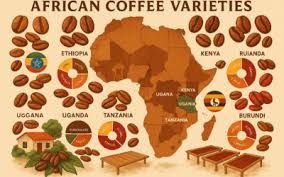
Coffee occupies a particularly important place in Africa’s agricultural and cultural landscape. The continent is the birthplace of Arabica coffee, with Ethiopia home to the world’s deepest reservoir of wild and semi-wild genetic diversity. Ethiopian coffees—from Yirgacheffe, Sidama, Guji, Harrar, Jimma, and beyond—are celebrated for their floridity, bright acidity, and incredible range of flavour profiles shaped by indigenous landrace varieties and complex highland microclimates. Kenya, another globally renowned origin, produces coffees known for their wine-like acidity, berry-forward Flavors, and strict quality grading systems. East Africa as a whole—including Tanzania, Rwanda, Burundi, Congo, and Uganda—offers an array of cup profiles ranging from sweet, tea-like, and floral to rich, chocolatey, and fruit-saturated. West and Central Africa, while historically less dominant in specialty Arabica production, contribute significantly to global Robusta supply, with countries like Uganda and Côte d’Ivoire playing key roles. Across the continent, coffee cultivation is overwhelmingly driven by smallholder farmers, many of whom rely on traditional, shade-grown agroforestry systems that support both environmental sustainability and rural livelihoods.
Yet Africa’s coffee sector faces challenges: climate change threatens rainfall patterns in highland regions, farm sizes remain small, access to capital is limited, and infrastructure constraints hinder consistency and market access. At the same time, new opportunities are emerging through expanded specialty markets, direct-trade relationships, improved cooperative structures, advanced processing techniques, and increasing global demand for traceable, high-quality African coffees. Investments in processing, soil health, climate resilience, and farmer training are enhancing quality and competitiveness across multiple producing countries.
Despite ongoing challenges in governance, climate resilience, and regional stability, Africa remains a continent of dynamic transformation—rich in natural resources, cultural heritage, and human potential. Its agricultural importance, technological innovation, and expanding urban economies position it as a central player in future global developments. With its deep historical roots, ecological diversity, and vibrant coffee cultures, Africa continues to shape global tastes and perspectives while standing as one of the most culturally and environmentally diverse regions on Earth.
.png)





No Comments Found!