Shopping cart
Your cart empty!
Your cart empty!
Terms of use dolor sit amet consectetur, adipisicing elit. Recusandae provident ullam aperiam quo ad non corrupti sit vel quam repellat ipsa quod sed, repellendus adipisci, ducimus ea modi odio assumenda.
Lorem ipsum dolor sit amet consectetur adipisicing elit. Sequi, cum esse possimus officiis amet ea voluptatibus libero! Dolorum assumenda esse, deserunt ipsum ad iusto! Praesentium error nobis tenetur at, quis nostrum facere excepturi architecto totam.
Lorem ipsum dolor sit amet consectetur adipisicing elit. Inventore, soluta alias eaque modi ipsum sint iusto fugiat vero velit rerum.
Sequi, cum esse possimus officiis amet ea voluptatibus libero! Dolorum assumenda esse, deserunt ipsum ad iusto! Praesentium error nobis tenetur at, quis nostrum facere excepturi architecto totam.
Lorem ipsum dolor sit amet consectetur adipisicing elit. Inventore, soluta alias eaque modi ipsum sint iusto fugiat vero velit rerum.
Dolor sit amet consectetur adipisicing elit. Sequi, cum esse possimus officiis amet ea voluptatibus libero! Dolorum assumenda esse, deserunt ipsum ad iusto! Praesentium error nobis tenetur at, quis nostrum facere excepturi architecto totam.
Lorem ipsum dolor sit amet consectetur adipisicing elit. Inventore, soluta alias eaque modi ipsum sint iusto fugiat vero velit rerum.
Sit amet consectetur adipisicing elit. Sequi, cum esse possimus officiis amet ea voluptatibus libero! Dolorum assumenda esse, deserunt ipsum ad iusto! Praesentium error nobis tenetur at, quis nostrum facere excepturi architecto totam.
Lorem ipsum dolor sit amet consectetur adipisicing elit. Inventore, soluta alias eaque modi ipsum sint iusto fugiat vero velit rerum.
Do you agree to our terms? Sign up
The Fraijanes Plateau
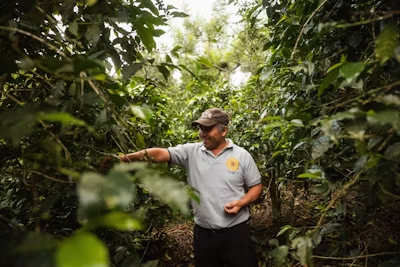
The Fraijanes Plateau is one of Guatemala's most dynamic growing regions, defined by its proximity to the country's most active volcano and its unique mineral-driven flavor profile.
1. Geography & Terroir
Volcanic Activity: The plateau is located just south of Guatemala City and is heavily influenced by the Pacaya Volcano, the most active in the country. Frequent eruptions deposit nutrient-dense, potassium-rich ash into the soil.
Altitude: Farms are situated at high elevations ranging from 1,400 to 1,800 meters (approx. 4,600–5,900 feet).
Soil Type: The soil is volcanic and high in potassium, which is a critical nutrient for cherry development and plant health.
Microclimate: The region experiences a distinct dry season with plenty of sunlight, which is ideal for drying coffee. However, the plateau is also prone to thick morning mists and variable humidity due to its high elevation and proximity to the coast.
2. Production & Scale
Harvest Dynamics: Because of the Pacaya's activity, farmers often have to wash volcanic ash off the leaves to prevent plant damage, adding a unique labor step to the production cycle.
Logistical Advantage: Its location near the capital city of Guatemala provides producers with excellent access to infrastructure, export dry mills, and international shipping routes.
2025 Outlook: Producers are increasingly focusing on Strictly Hard Bean (SHB) certifications and sustainability practices to mitigate the impacts of erratic rainfall patterns observed during the 2024–2025 growing season.

3. Varietal Profile
Fraijanes focuses on high-quality Arabica varieties that thrive in mineral-heavy soil:
Bourbon: The primary variety used to produce the region's characteristic sweetness.
Caturra & Catuai: These are favored for their ability to withstand the intense sunlight of the plateau’s dry season while maintaining high yields.
Pache: Common in the older estates of the region, contributing to a smooth, balanced cup.
Newer Hybrids: To combat the humid mists that can encourage fungal growth, some farmers are integrating Anacafé 14 and other rust-resistant hybrids.
4. Flavor & Processing
Primary Process: The Washed Process is the gold standard here. The region’s abundant sun during the harvest months allows for efficient sun-drying on concrete patios, which results in a very clean and bright cup.
Flavor Profile:
Acidity: Notable for its bright and persistent acidity, which is often more aggressive and "crisp" than the more rounded acidity found in Antigua.
Body: Medium to full-bodied, often described as having a "clean" or "smooth" mouthfeel.
Notes: Distinctive for its floral aromatics and bright fruit notes (red apple, citrus) layered over a classic base of milk chocolate and roasted nuts.
Harvest Window: The peak harvest period occurs from December through March.