Shopping cart
Your cart empty!
Your cart empty!
Terms of use dolor sit amet consectetur, adipisicing elit. Recusandae provident ullam aperiam quo ad non corrupti sit vel quam repellat ipsa quod sed, repellendus adipisci, ducimus ea modi odio assumenda.
Lorem ipsum dolor sit amet consectetur adipisicing elit. Sequi, cum esse possimus officiis amet ea voluptatibus libero! Dolorum assumenda esse, deserunt ipsum ad iusto! Praesentium error nobis tenetur at, quis nostrum facere excepturi architecto totam.
Lorem ipsum dolor sit amet consectetur adipisicing elit. Inventore, soluta alias eaque modi ipsum sint iusto fugiat vero velit rerum.
Sequi, cum esse possimus officiis amet ea voluptatibus libero! Dolorum assumenda esse, deserunt ipsum ad iusto! Praesentium error nobis tenetur at, quis nostrum facere excepturi architecto totam.
Lorem ipsum dolor sit amet consectetur adipisicing elit. Inventore, soluta alias eaque modi ipsum sint iusto fugiat vero velit rerum.
Dolor sit amet consectetur adipisicing elit. Sequi, cum esse possimus officiis amet ea voluptatibus libero! Dolorum assumenda esse, deserunt ipsum ad iusto! Praesentium error nobis tenetur at, quis nostrum facere excepturi architecto totam.
Lorem ipsum dolor sit amet consectetur adipisicing elit. Inventore, soluta alias eaque modi ipsum sint iusto fugiat vero velit rerum.
Sit amet consectetur adipisicing elit. Sequi, cum esse possimus officiis amet ea voluptatibus libero! Dolorum assumenda esse, deserunt ipsum ad iusto! Praesentium error nobis tenetur at, quis nostrum facere excepturi architecto totam.
Lorem ipsum dolor sit amet consectetur adipisicing elit. Inventore, soluta alias eaque modi ipsum sint iusto fugiat vero velit rerum.
Do you agree to our terms? Sign up
Coban
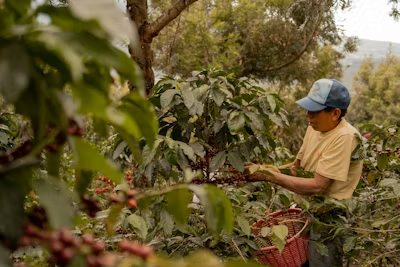
Cobán is distinct for its tropical rainforest environment, characterized by constant mist and high humidity that create a profile starkly different from Guatemala’s volcanic regions.
1. Geography & Terroir
Climate & Mist: The region is famous for the chipi-chipi, a persistent, fine drizzle and thick mist that keeps the air humid and cool year-round.
Altitude: Coffee is grown between 1,300 and 1,800 meters (4,200–5,900 ft) on rain-soaked hillsides.
Soil: Unlike the volcanic regions, Cobán sits on limestone-rich, clay-heavy soils that are highly fertile and support diverse tropical flora.
Microclimate: High relative humidity (85–95%) and heavy annual rainfall (3,000–4,000 mm) lead to a late-maturing crop and a very green, lush landscape.
2. Production & Scale
Smallholder Dominance: Most production comes from small family-run farms that have operated for generations.
Processing Challenges: The constant chipi-chipi makes traditional patio sun-drying extremely difficult. As a result, smallholders often sell their coffee as cherry or wet parchment to central mills equipped with mechanical dryers.
Regional Importance: Cobán ranks as the 5th largest coffee-producing region in Guatemala.

3. Varietal Profile
Traditional and modern Arabica varieties are used to balance quality with disease resistance in the damp climate:
Core Varieties: Bourbon, Caturra, and Catuai are the traditional staples.
Rust-Resistant Varieties: Due to the high humidity, varieties like Anacafé 14, Obata, Catimores, and Sarchimores are increasingly common to combat coffee leaf rust.
Maracaturra: Some estates in the broader Alta Verapaz area cultivate this large-bean hybrid for its unique acidity and high yield.
4. Flavor & Processing
Processing Methods: While the Washed Process is traditional, producers are increasingly experimenting with Honey and Natural processes to improve sensory quality and profitability.
Flavor Profile:
Acidity: Mild but bright, often described as "delicate" or "citrusy" (blond orange, green apple).
Body: Generally medium to full, with a smooth, velvety mouthfeel.
Notes: Distinguished by cocoa and fresh fruit (berry, mulberry) with occasional spicy or wine-like undertones and floral aromatics like jasmine.
Harvest Window: The harvest typically runs from December through March.